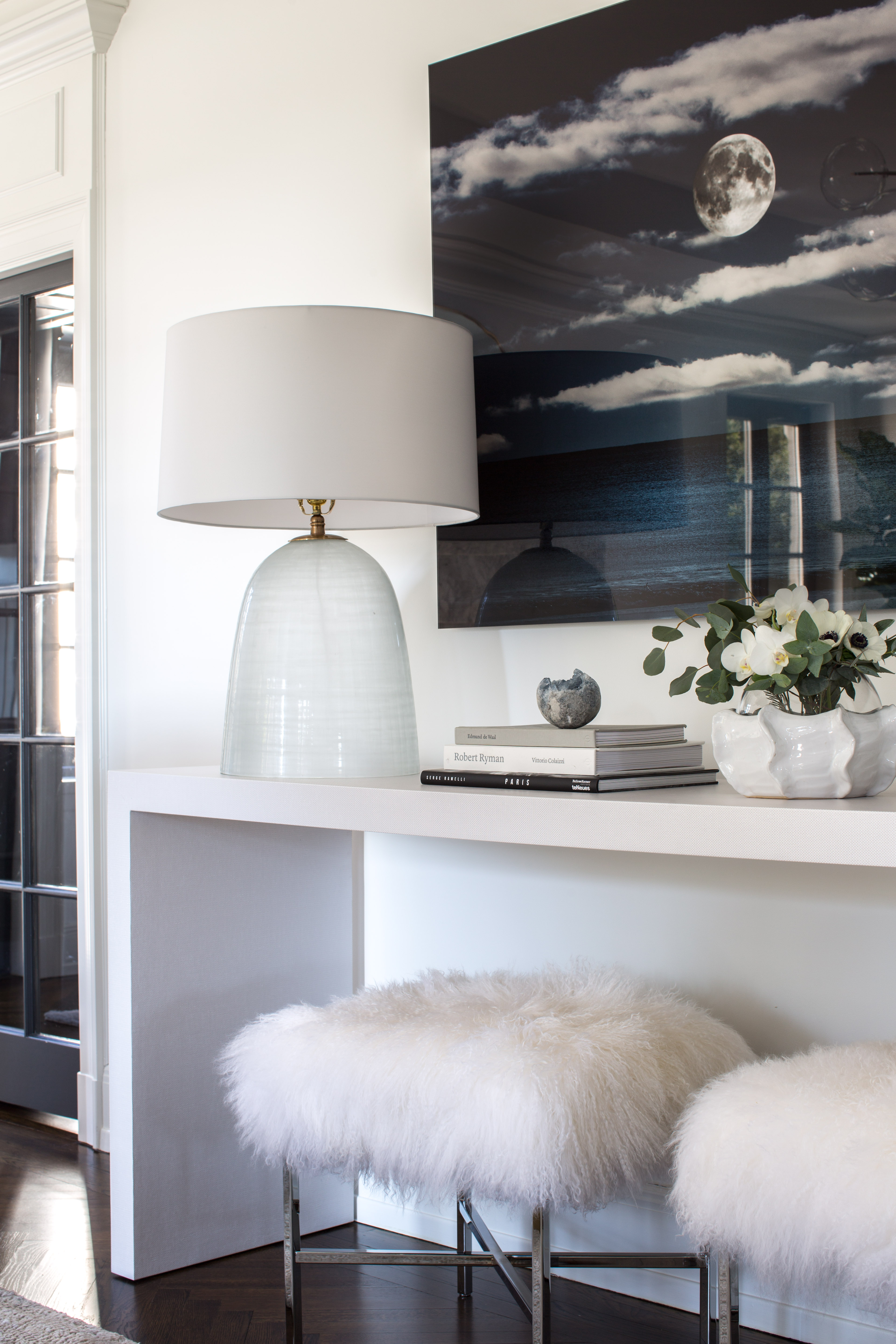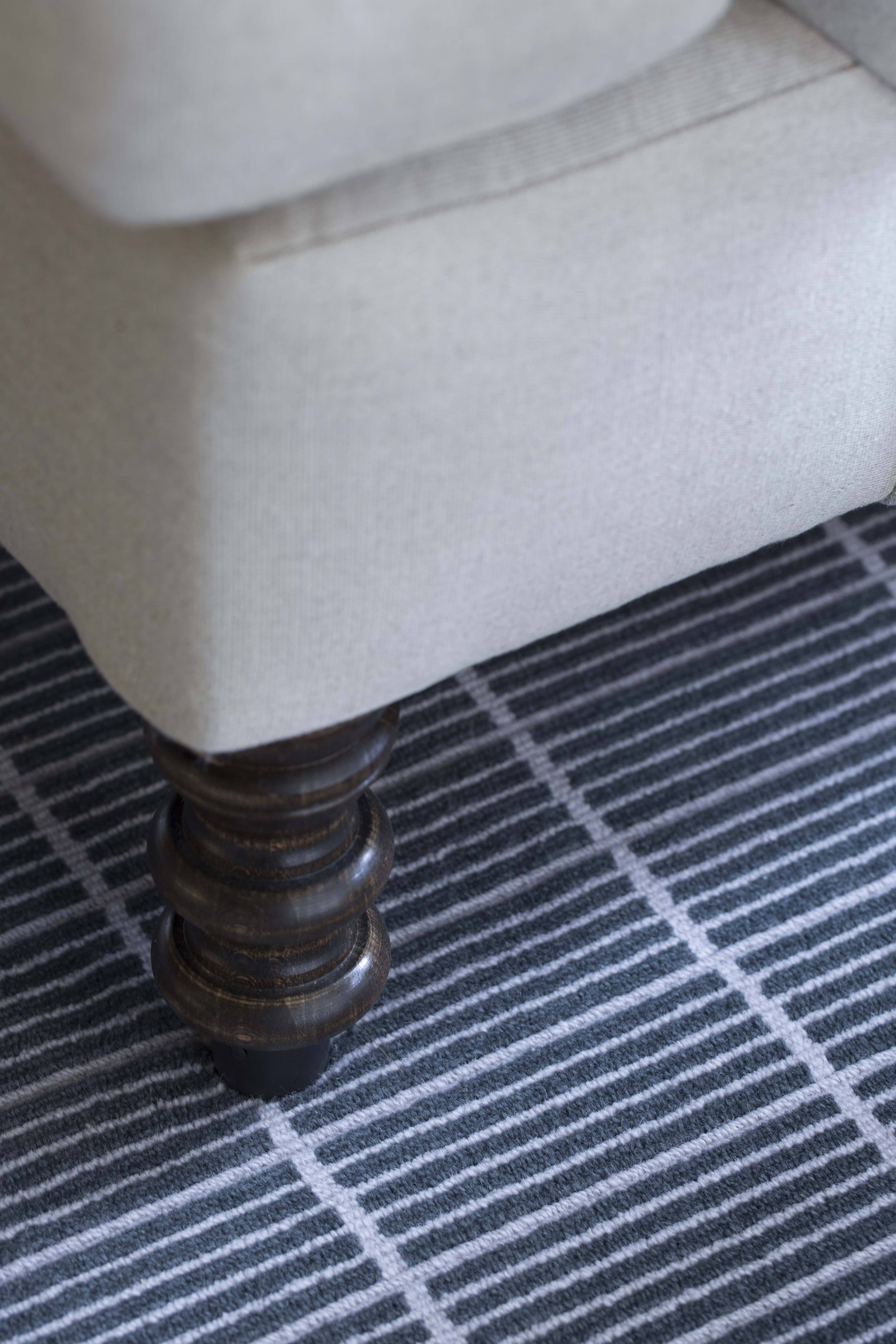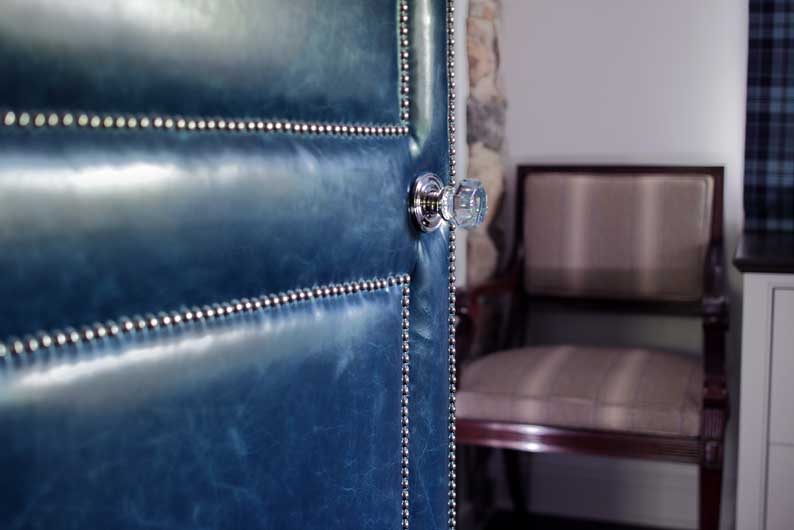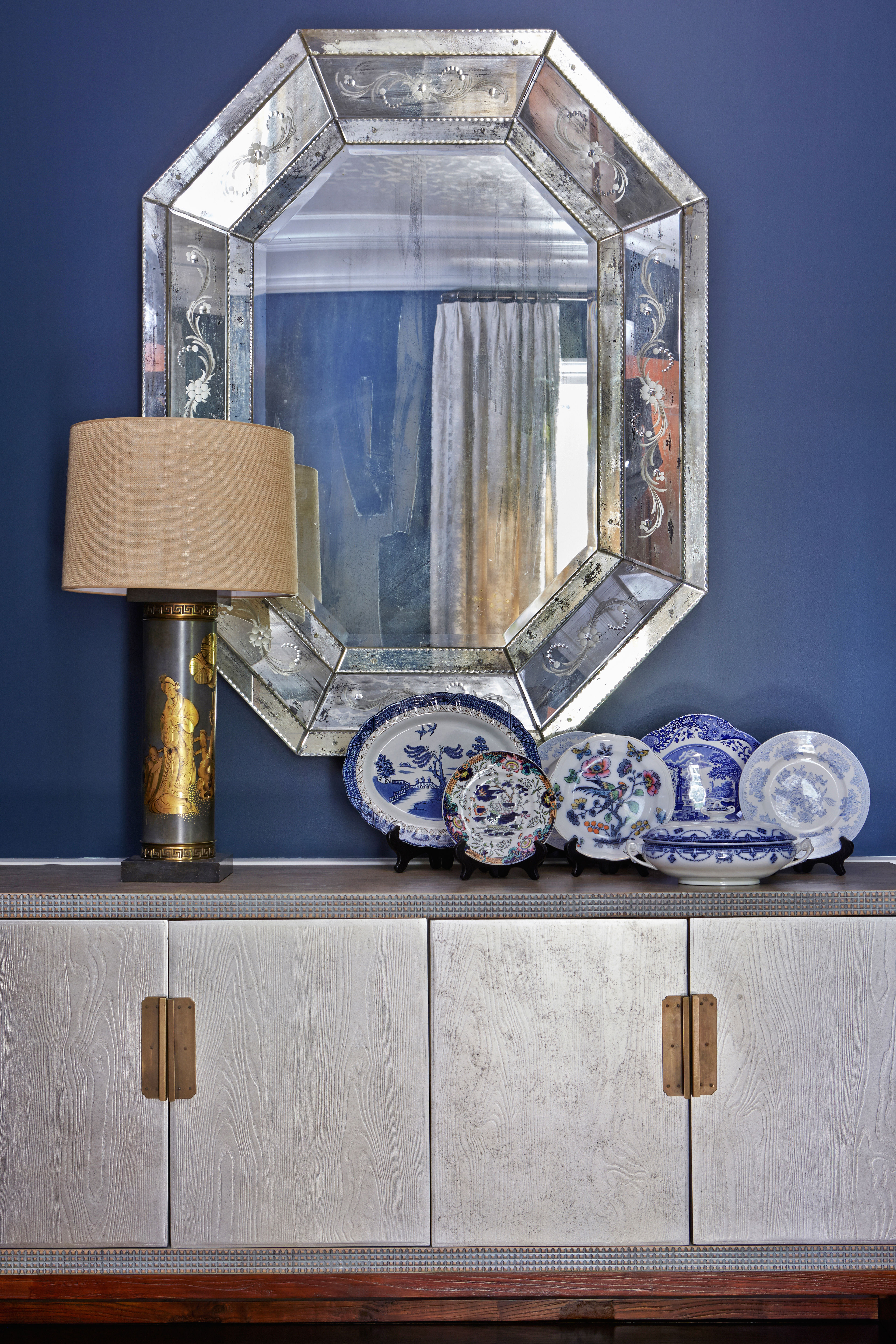
Celadon is a great color for spring! It’s fresh, pretty, and pairs well with a variety colors. With blue and grey, celadon looks sophisticated and soothing. When paired with more vibrant hues, it balances out energetic colors for a well-rounded look. Celadon works with so many other colors because it stems from ocean blues, hazy greys, and muted greens. It definitely has a real zen-like quality!
1. Paraty Leather Shoulder Bag
2. Hand painted wallpaper from Gracie Studio
3. Dining room design by Suzanne Kasler
4. Evening gown by Zac Posen
5. Sage Wisdom from Benjamin Moore
6. Chic celadon. Image via Vogue.
7. Maribel Lantern Lamp by Coleen & Company
8. Celadon Grasscloth Wallpaper by The Wallpaper Company
Blue is a safe color that a lot of people gravitate toward. With so many different shades of blue, it can be bright, serene, bold, subtle, or dramatic. You can drench a room in blue or use it as a strong accent color. In fashion, blue looks good on almost anyone and pairs well with a lot of other hues. What do you think of blue?
1. Blue Living Room via Home Ideas Mag
2. Blue Agate from Concetto
4. Bluestone
5. Custom chair in a client’s home.
6. Christian Louboutin Lady Highness
7. Quadrille Fabrics, image via House Beautiful
8. June Short Pleated Peplum Dress by Alice and Olivia
9. Ornate blue door, image via W5RAn
Lately I have really been loving lucite. For me it evokes the 1970s, a decade that I could happily live in forever. In fashion and design, lucite accents add a modern chic touch. It is strong, crystal clear, and easy to shape into any number of things. Because lucite is nearly invisible, it brings brightness to a space without visually cluttering up a room. It can work with any color and, when done correctly, looks so classy. Here are some examples of lucite pieces that caught my eye.
1. Brass and Lucite Mirror by Charles Hollis Jones, c. 1970
2. Great benches from CocoCozy.
3. This lucite tray from Eclectic Cool is a great accent on a ottoman.
4. A Place in the Clouds: Bedroom design by Jennifer Post.
5. Lucite overload! Image via Marie Burgos Design Blog
6. Polished Steer Horns on Lucite
7. Great hardware from Nest Studio.
8. Mongolian Lamb Bench by Jonathan Adler.
9. Clear heels from Le 21eme
10. George II Chair from Plexi-Craft
11. Pandora Clutch
12. Joss and Main coffee table
I’ll be honest with you — I’m not obsessed with the color pink. It’s just not my go-to color on the wheel. It always seems like such a stereotypical, over-used “girl color” to me, but it also makes me think of bubblegum and Pepto-Bismol. It’s not an easy color to design with, but I can appreciate it in certain elements. I love pink flowers and reading Pinkalicious with my very girly-girl four year old. Pink has also become a positive symbol for breast cancer research and awareness. Many women look beautiful in pink, which exudes femininity. It makes people think of spring, flowers, hope, and happiness. I don’t know about you, but as we endure yet another snow day here, I could use a reminder of spring! What do you think of pink?
1. Photography by Waldemar Hansson
2. Princess Pink from Benjamin Moore
3. Chloe Marcie Leather Handbag
4. Alexander McQueen Skull Embellished Watersnake Ballet Flats
5. Bedroom design by Amanda Nisbet
6. Retro pink fridge from Smeg
7. Pink shagreen box with brass inlay from Galart International
8. Square in Square rug in Rose by Vanderhurd
9. Oil painting by Kate Perkins
March is Women’s History Month, a time to reflect on the contributions of incredible women to all aspects of life. It’s a time to show appreciation and respect for the women who made history through their courage, style, and refusal to accept the limitations placed on them by society and the times they lived in. When I think of influential women who helped shape their worlds, three names instantly come to mind: Coco Chanel, Elsie de Wolfe, and Sister Parish. These women changed the world of design and fashion and I truly admire all they accomplished. Each of them is an icon, a forecaster whose designs still work today.
Coco Chanel was an inspiration for women in era when the world was all about men. Born Gabrielle Chanel in the Loire Valley of France in 1883, she grew up impoverished with a strict convent education. Her early life inspired her to take her own direction, first on the stage (where she earned the nickname Coco) and then as a milliner. Chanel opened her first shop in Paris in 1913, selling hats and garments. Her practical designs led to a devoted clientele which boomed as people flocked to Paris at the start of WWI. Her ideas of how women should look, act, and dress had a profound effect on her designs, letting women leave corsets behind and take on more active pursuits. The enduring popularity and success of the Chanel brand is a direct result of Coco’s ability to package and market her own personal style and freer attitudes. Coco Chanel navigated through difficult times as well, including the closure of her salon during WWII. In the early 1950′s and at an advanced age compared to her contemporary designers, Coco reentered the world of fashion design, updating her style while staying true to her own classic approach. Even after her death in 1971, her name and brand continue to be associated with haute couture design as well as an inspiration to the world of fashion.
It would be difficult to think of a woman who did more for the world of interior design than Elsie de Wolfe. Born in America around 1865, she became an interior designer when such a thing didn’t yet exist, especially for women. At that time, interiors were put together by upholsterers and architects. Elsie succeeded in transforming dark Victorian interiors into light, stylish homes featuring practicality and fresh colors. American homes were introduced to sophisticated, vibrant, and comfortable style for the first time. What I find most surprising about Elsie de Wolfe’s design career is that she didn’t start designing until she was 40 years old. Prior to that, she was an actress and society figure who became interested in design while staging plays. She studied the French lifestyle and approach to art, entertainment, food, and fashion and used that influence in her designs. Her clients included the likes of Anne Vanderbilt and the Duke and Duchess of Windsor. According to The New Yorker, “Interior design as a profession was invented by Elsie de Wolfe.” She was truly a pioneer!
Dorothy May Kinnicutt grew up the only girl in a family with five children, leading to her lifelong nickname of Sister. In 1930 she married Henry Parish and opened her decorating firm in suburban New Jersey in 1933. Up to that point, she had designed the interiors for her family’s country home, several neighbors’ homes, and a nearby restaurant. She was credited with ushering in the American country style of the 1960s. When she hired Albert Hadley, the pair became a design legend. Parish is perhaps best known for her designs in the Kennedy White House as well as the influence she had on an entire generation of New York designers. Parish herself said, “As a child, I discovered the happy feelings that familiar things can bring — an old apple tree, a favorite garden, the smell of a fresh-clipped hedge, simply knowing that when you round the corner, nothing will be changed, nothing will be gone. I try to instill the lucky part of my life in each house that I do. Some think a decorator should change a house. I try to give permanence to a house, to bring out the experiences, the memories, the feelings that make it a home.”
It’s hard to quantify the influence of women on today’s world of fashion and design, but these giants of design made themselves into household names and have inspired generations of girls to follow their own dreams without compromise.
I absolutely love black! I wear it just about every day. Something about black makes me think of confidence, so I feel stronger when I’m wearing it. In interior design, black makes a dominant accent color, especially when used in a key area of the room. You can’t be wary of black when designing with it; you have to be bold and fearless, whether you choose to use it for paint, furniture, or fabric. I am obsessed with it!
2. Lens Chandelier by Holly Hunt
3. Karl Springer Coffee Table from Todd Merrill Antiques
4. Bagatelle Spot wallpaper from Osborne and Little
5. Blackman Cruz Neoclassic Dining Chair
6. Michael Kors Black Leather Hobo
7. Benjamin Moore Black Satin
9. Black tulips: I love these!
10. Christian Louboutin Diplonana Black Leather
Each year, Pantone announces its choices for the Top Ten Women’s Colors for Spring and their Color of the Year. This influential forecast highlights color trends in both fashion and design. I always look forward to Pantone’s list because it’s great to see how their choices compare with my own changing preferences as well as trends among my clients.
My three favorite colors from this list are Lemon Zest, Grayed Jade, and Emerald, the Color of the Year. In fact, I was pretty close to the mark last year when I created my Jade Color Board and my Yellow Color Board!
Lemon Zest is both bright and soothing. It’s not a color I would have naturally gravitated toward in the past, but it stands out and and really has a mood-lifting effect. I like it more and more as time goes on!
Grayed Jade’s soft, subtle hue appeals to my more traditionalist nature. It pairs well with other shades and is a calm alternative to brighter greens and a more romantic alternative to simple gray. It communicates elegance and sophistication.
Emerald, Pantone’s Color of the Year, is also my favorite color from their Top Ten list for Spring. Emerald is such a chic and glamorous color, bringing to mind gems and luxury. For all its elegance, Emerald is also an energetic color that injects any space with a vibrant depth.
What do think of Pantone’s Top Colors for Spring and Color of the Year? Which colors do you prefer from the list? I look forward to a New Year of exciting design opportunities and challenges, as well as the chance to incorporate some of these colors into my own designs!
According to legend, the Chinese zodiac originated long ago with the Jade emperor. The emperor decided there should be some way of measuring time, and so challenged the animals to a swimming race across a swift river. The first 12 animals to complete the race would each have a year named after them. The story says 13 animals raced, with the cat coming in last after being tricked by the rat. The sixth animal to complete the race was the sneaky snake.
Tomorrow marks the start of 2013, the Year of the Snake. Snake characteristics include traits such as intelligence, motivation, and influence. In honor of the Year of the Snake, I’d like to use today’s blog post to look at the influence of snake imagery and snakeskin on the worlds of design and fashion.
Snakeskin is a very conceptual texture, something a lot of people love. It’s not for everyone and typically works best in small doses. Snakeskin is about confidence and bringing out your inner fangs!
The use of snake imagery doesn’t have to be literal. It can be incorporated into hardware or mirrors or simply suggested in shapes and lines. Snakeskin is a dramatic choice as well. I used this gorgeous Maya paper on the face front of interior doors in a NYC residence with really amazing results. It’s high glamour, over-the-top chic that doesn’t scream “reptile.”
In fashion, snakeskin is all about confidence and bringing out your inner fangs! I sport snakeskin about once a week on my shoes or bag. It’s a really bold pattern and I love it!
What does the Year of the Snake have in store for you?
Quintessence is a lifestyle blog I really enjoy. Written by Stacey Bewkes, Quintessence focuses on “those special discoveries that make life just that much better.” After working as an art director in NYC for 17 years, Stacey left that world to raise her four children in Connecticut. She then created Quintessence to continue to say involved in every aspect of the world of design and fashion. Stacey attends design, lifestyle, and fashion events, and then blogs about them to bring the experience to her readers. She also shares content on topics from art to movies and food to books, meaning you’ll always find something new and interesting at Quintessence.
Quintessence appeals to me because it is very cultured. Stacey is worldly and involved and is always current on what’s happening. She really does her homework and is clearly knowledgeable. Her posts are interesting and relevant. Having had the opportunity to meet Stacey, I know she is a lovely lady, very passionate and direct!
One of my favorite Quintessence posts was about NIBA rugs. It jogged my memory of a source I had seen before but hadn’t logged into my mental catalog of go-to rugs. I am so excited to incorporate some of these rugs into my interiors!
Red is simply a sexy, va-va-voom color. It makes people think of lipstick, fast cars, love, and risk. Red excites people with an enticing, energetic jolt of color. Brunettes and blonds look great in red, and it’s hard to think of a color that implies more emotion. You can saturate an entire room in this bold palette or wear it all over for a glamorous night out!
1. Stitched Puzzle wallcovering from Maya Romanoff
2. Lantern by Urban Electric, custom colored for Amy Aidinis Hirsch Interior Design. Photo by Neil Landino.
3. Mark Rothko
4. Chair by Duralee with Yoma fabric for a client of AAH. Photo by Neil Landino.
5. 1960 Mercedes-Benz 300SL Roadster
6. Living room with red accents, design by AAH. Photo by Neil Landino.
7. Christian Louboutin, Platform Red Pumps
8. A-line Mini Dress from Victoria Beckham
9. Custom sofa design by AAH. Photo by Neil Landino.
10. Red and white design. Image via High Street Market.
**Cover image design by Brian McCarthy via Elle Decor